

OZEN for Professionals
THE CLINICAL CHALLENGE
A common condition that remains difficult to resolve
Dentine hypersensitivity is one of the most frequently encountered pain-related conditions in everyday practice. It presents as a short, sharp pain arising from exposed dentine in response to thermal, tactile, osmotic or chemical stimuli.
The widely accepted hydrodynamic theory holds that this pain is triggered when exposed dentinal tubules allow fluid movement within the dentine, stimulating pulpal nerve endings. Reducing dentinal tubule permeability therefore remains one of the most established approaches to managing sensitivity.
The unmet need
Despite a wide range of available desensitising technologies, many patients continue to experience sensitivity during everyday activities such as eating, drinking and toothbrushing. Clinicians frequently see patients who have already tried conventional sensitivity toothpastes yet still report ongoing symptoms.
There remains a clear need for technologies that can deliver a rapid improvement, long-lasting protection and reliable performance under real-world oral conditions.
Patented Aerograft™ Technology
A new class of bioactive material for dentine hypersensitivity
OZEN is built around a patented bioactive Aerograft™ technology developed from research at University College London and invented by Dr Niall Kent, an Oral and Maxillofacial Surgeon and Member of the Royal College of Surgeons of England, uniquely qualified as a doctor, dentist and PhD.
The technology was originally derived from advanced aerogels explored for bone grafting, materials designed to interact with hard tissues such as bone and teeth. For OZEN, that architecture was adapted for the oral environment and made bioactive by incorporating calcium and phosphate, the mineral building blocks of natural tooth structure.
Unlike conventional desensitising technologies, the OZEN bioactive aerogel has an ultra-high surface area, a low-density structure and an optimised particle size distribution. This allows it to interact rapidly with saliva and exposed dentine on application.
The aerogel is carried in a specially formulated, low-water oral care base that preserves its reactivity during storage, a formulation that took three years to develop and contains 0% titanium dioxide and 0% SLS.
Clinical Evidence
Results from a dentist controlled clinical study
OZEN Sensitive Toothpaste was evaluated in an independent, dentist-controlled, randomised crossover clinical study against a leading benchmark toothpaste.
Study design
- 88 adults clinically diagnosed sensitivity sufferers.
- Randomised crossover design, with each participant acting as their own control.
- One group used OZEN for 28 days before crossing over to the benchmark following a washout period; the second group followed the reverse sequence.
- Sensitivity assessed at baseline, after first use, and after 28 days for each product.
- The crossover design was selected to minimise inter-patient variability and provide a robust comparison under normal daily oral hygiene conditions.
Key findings
OZEN produced a statistically significant reduction in sensitivity after a single application (p < 0.05), with a mean sensitivity reduction of approximately 89% following initial use.²
Sensitivity reduction improved with ongoing use. After 28 days, OZEN produced a statistically significant reduction versus baseline (p < 0.05).
A clinically relevant improvement was observed in 100% of evaluated subjects after 28 days. Investigators confirmed the positive effect of the product across the study population.¹
At every monitored assessment point, OZEN showed statistically significantly greater improvement than the benchmark leading toothpaste.
The product showed excellent oral tolerability throughout, with no significant concerns regarding mucosal irritation or product safety identified by investigators.
Clinical significance
Dentine hypersensitivity remains a common challenge, particularly in patients with exposed root surfaces, periodontal maintenance needs and whitening-associated sensitivity. These results indicate rapid and sustained sensitivity reduction under normal use, achieved against an established benchmark rather than an untreated control. The findings are consistent with the mineral deposition demonstrated in laboratory testing.
Real-World User Evaluation
What patients reported
Alongside objective clinical measures, participants reported their own experience after 28 days of use:
would recommend the product¹
reported reduced sensitivity in situations that would normally trigger discomfort²
reported improved ability to enjoy hot and cold foods and drinks.²
reported less sensitivity associated with whitening treatment.¹
These patient-reported outcomes align with the objective clinical findings, supporting OZEN's relevance in everyday patient experience as well as under controlled assessment.
Clinical Applications
Where OZEN may support patient care
OZEN is designed for use across the range of presentations where dentine hypersensitivity is a factor, including:
- General dentine hypersensitivity in patients seeking a faster or more effective result than conventional sensitivity toothpastes have provided.
- Exposed root sensitivity, including gingival recession and exposed cervical or root surfaces.
- Whitening-associated sensitivity, before, during or after whitening treatment, supported by patient-reported outcomes in this group.
- Periodontal maintenance, where exposed surfaces and ongoing maintenance needs contribute to sensitivity.
- Post-procedural sensitivity, for example following scaling, root surface debridement or restorative work.
Clinical Protocols & Professional Guidance
Integrating OZEN into patient pathways
Everyday use
- Brush twice daily with OZEN in place of the patient's regular toothpaste.
- For best results, encourage consistent twice-daily use to support cumulative mineral deposition.
Targeted application
- For localised or acute sensitivity, the paste can be applied directly to the affected area and left in place, rather than rinsed immediately, to maximise contact time.
In-practice and post-procedural use
Consider application following procedures associated with transient sensitivity, such as scaling or whitening.
Patient guidance
- Set expectations around rapid first-use improvement alongside continued benefit over the first weeks of use.
- Reinforce that ongoing use sustains and strengthens the protective effect.
The expertise behind OZEN
OZEN's clinical and scientific strategy is supported by experts across periodontology, hygiene and therapy, general dentistry, research and oral care commercialisation.
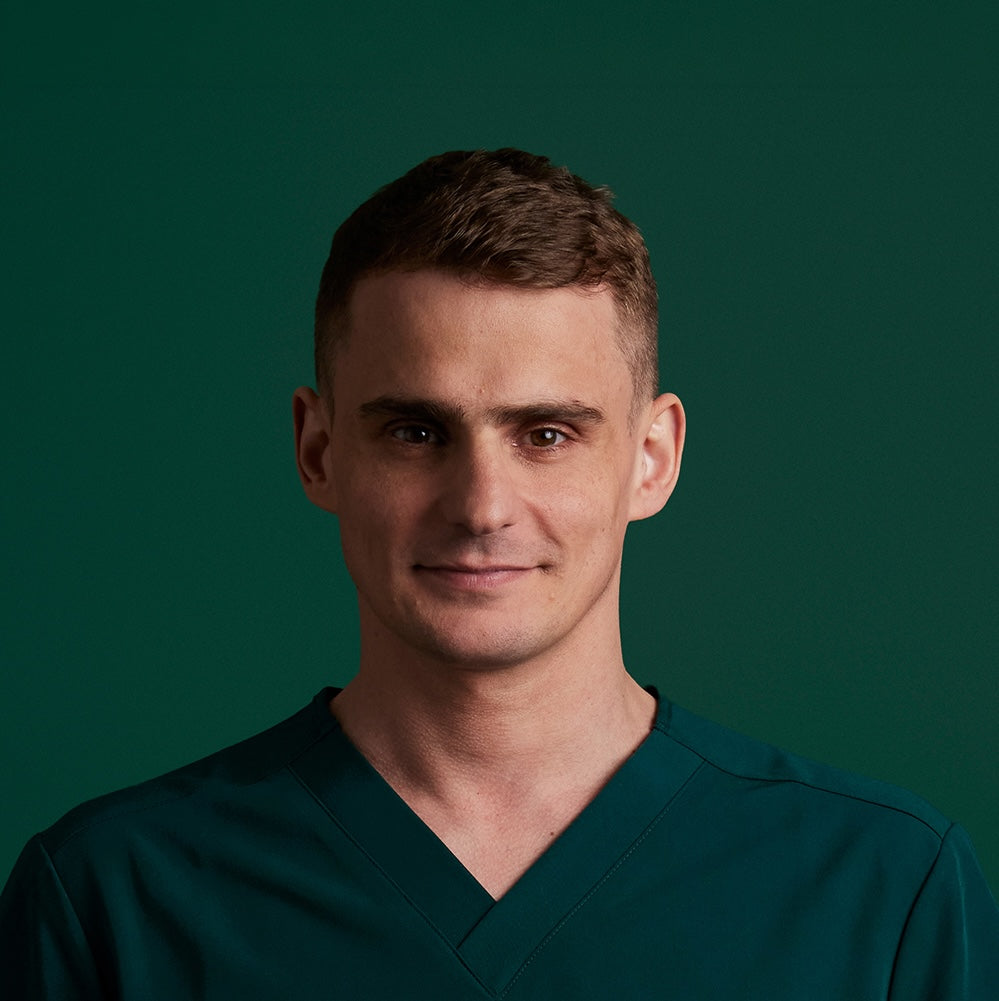
Dr Niall Kent, Inventor and Clinical Lead
Dr Niall Kent is an Oral and Maxillofacial Surgeon based in London and a Member of the Royal College of Surgeons, with a background spanning medicine, dentistry, biomaterials research and oral health innovation.
He trained in medicine at the University of Warwick and in dentistry at King's College London, and holds a PhD from Barts and The London School of Medicine and Dentistry, where his research focused on novel calcium phosphate formulations from bioactive glass. His scientific work has centred on biomaterials, mineralisation and hard tissue regeneration, the fields that underpin OZEN's technology.
Alongside his clinical work, he has held research and academic roles at University College London, including as an Honorary Lecturer in Chemical Engineering. He has filed several patents, presented internationally and received multiple innovation and research awards, including recognition from UCL Innovation and Enterprise, Warwick Medical School and the Royal Academy of Engineering.
OZEN was inspired by his experience treating patients with oral pain, sensitivity and discomfort in clinic and A&E, and his goal is to bring genuinely new biomaterial science into everyday oral care: clinically informed, scientifically grounded and designed for real life.